

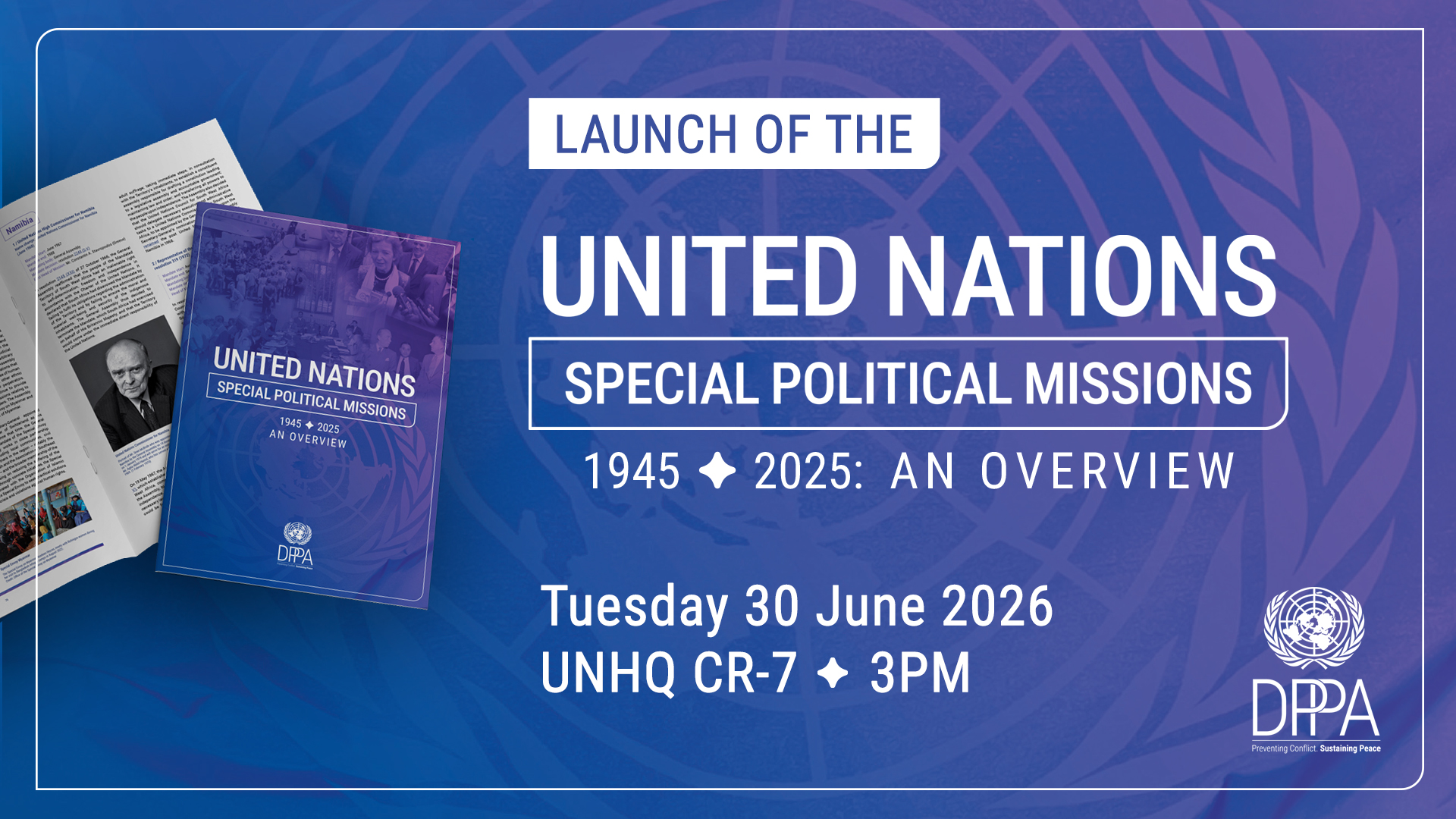
30 June 2026 | New York – The United Nations Department of Political and Peacebuilding Affairs (DPPA) launched a new publication, United Nations Special Political Missions: 1945–2025 – An Overview, tracing eight decades of UN efforts to prevent conflict, support peace processes and advance political solutions around the world.
The publication brings together, for the first time, a comprehensive historical record of UN special political missions (SPMs), documenting their evolution and contributions to international peace and security. From supporting decolonization and political transitions to facilitating peace agreements and preventive diplomacy, these missions have played a central role in the history of the United Nations.
“For eight decades, special political missions have stood at the heart of the United Nations’ most consequential achievements,” said Under-Secretary-General (USG) for Political and Peacebuilding Affairs Rosemary DiCarlo at the launch event.
Despite their longstanding role, she noted, the United Nations had never compiled a comprehensive record of all special political missions deployed since 1948.
“This publication is not only a record of the past; it is a reminder of what is possible,” she said.
Eight decades of diplomacy and political engagement
The history of special political missions dates back to 1948, with the appointment of the first UN mediator in Palestine. Since then, they have evolved into a diverse range of civilian missions, including special envoys, regional offices, investigative bodies and missions supporting complex political transitions.
Highlighting examples from across the decades, USG DiCarlo recalled the role of special political missions in supporting independence processes in Africa and the Middle East, facilitating negotiations during the Cold War, helping implement peace agreements in Central America and elsewhere, and accompanying South Africa's transition from apartheid.
She emphasized three lessons from this history: geopolitical divisions must not become an excuse for inaction; adaptability remains a defining strength of special political missions; and effective partnerships with Member States, regional organizations and other actors are essential to their success.
Lessons for the future of UN peace operations
The launch brought together representatives of Member States, UN leadership and independent experts to reflect on the continued relevance of special political missions amid an increasingly complex global peace and security landscape.
Ambassador Leonor Zalabata Torres, Permanent Representative of Colombia and President of the Security Council for June, highlighted the role of special political missions in facilitating dialogue, supporting reconciliation and strengthening national peacebuilding efforts. She welcomed the publication as a contribution to institutional knowledge and ongoing discussions on the future of UN peace operations.
Ambassador José Alberto Briz Gutiérrez, Permanent Representative of Guatemala and Chair of the General Assembly's Fourth Committee, underscored the historical relationship between special political missions and the realization of self-determination. Drawing on Guatemala's own peace process, he emphasized the importance of national ownership, sustained political dialogue and international accompaniment.
Joining remotely, Carlos Ruiz Massieu, Special Representative of the Secretary-General for Haiti and Head of the United Nations Integrated Office in Haiti (BINUH), shared experiences from his leadership of special political missions in Colombia and Haiti. While the two missions operate in markedly different contexts, he noted that both illustrate the importance of focused mandates, flexibility, national ownership and trust in the United Nations.
Shamala Kandiah-Thompson, Executive Director of Security Council Report, highlighted the versatility of special political missions as instruments of preventive diplomacy and political engagement. She also cautioned that missions cannot substitute for political will, stressing that their effectiveness ultimately depends on the political conditions in which they operate.
During the discussion, Member State representatives welcomed the publication and called for continued reflection on lessons learned, including how historical experience could inform the design and implementation of future mandates.
Looking ahead, USG DiCarlo pointed to the Secretary-General's forthcoming review of the future of UN peace operations, which will examine ways to strengthen peacemaking, develop more focused and adaptable mandates, deepen partnerships and ensure that missions remain effective in responding to evolving challenges.
At a time of growing geopolitical divisions and increasing demands for preventive diplomacy, the new publication offers a resource for Member States, researchers and practitioners seeking to better understand the UN's experience in advancing political solutions.
As USG DiCarlo concluded, the history of special political missions demonstrates that “even in the most difficult of circumstances, dialogue can open doors, patience can build trust, and diplomacy can change the course of history.”
Read the publication: United Nations Special Political Missions: 1945–2025 – An Overview


