Fourteen UN department, agencies, programmes and funds play a role in mine-action programs in 30 countries and three territories. A policy developed jointly by these institutions (Mine Action and Effective Coordination: the United Nations Inter-Agency Policy) guides the division of labor within the United Nations. Much of the actual work, such as demining and mine-risk education, is carried out by nongovernmental organizations. But commercial contractors and, in some situations, militaries, also provide humanitarian mine-action services. In addition, a variety of intergovernmental, international and regional organizations, as well as international financial institutions, also support mine action by funding operations or providing services to individuals and communities affected by landmines and explosive remnants of war.
The Strategy presents the common objectives and commitments that will guide the UN in mine action over the next 6 years. DOWNLOAD THE PDF
- The vision of the United Nations is a world free of the threat of landmines and explosive remnants of war, where individuals and communities live in a safe environment conducive to development and where the needs of victims are met.
The inter-agency partners working towards the achievement of this vision are:
- UN Department of Peacekeeping Operations (DPKO)
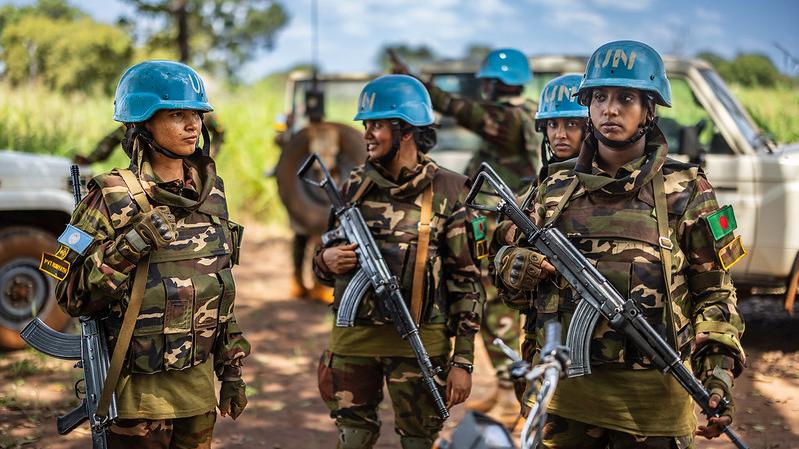
- DPKO integrates mine action into worldwide UN peacekeeping operations in line with a November 2003 Presidential Statement of the Security Council. Mr. Hervé Ladsous, the Under-Secretary-General for Peacekeeping Operations chairs the Inter-Agency Coordination Group on Mine Action, which brings together representatives from all UN mine-action entities. UNMAS provides direct support and assistance to UN peacekeeping missions. Careers & Business Opportunities
- United Nations Office for Disarmament Affairs (UNODA)
- UNODA advises and assists the UN Secretary-General in his work related to the Anti-Personnel Mine-Ban Treaty and the Convention on Certain Conventional Weapons. ODA promotes universal participation in international legal frameworks related to landmines and explosive remnants of war and assists countries in complying with their treaty obligations Careers & Business Opportunities
- United Nations Children's Fund (UNICEF)
- UNICEF was created to work with others to overcome the obstacles that violence, poverty, disease and discrimination place in a child's path. This includes children in mine-affected countries globally. UNICEF supports the development and implementation of mine risk education and survivor assistance projects and advocacy for an end to the use of landmines, cluster munitions and other indiscriminate weapons. Careers & Business Opportunities
- United Nations Mine Action is also supported by:
- Food and Agricultural Organisation (FAO)
- The FAO has a mandate to provide humanitarian relief, which sometimes requires the organization to participate in mine action in complex emergencies, particularly in rural areas.
- Office for the Coordination of Humanitarian Affairs (OCHA)
- OCHA shares information with all other organizations about the humanitarian impact of landmines and works with UNMAS on resource mobilization. OCHA is manager of the UN Central Emergency Revolving Fund and coordinator of the "Consolidated Appeal Process," both of which provide or mobilize financial resources for mine action.
- UN High Commissioner for Human Rights (OHCHR)
- The OHCHR does not have any specific mandate in the field of mine action, but it does carry out several relevant projects. OHCHR, for example, seeks to protect the rights people with disabilities, including survivors of landmines or unexploded ordnance.
- World Food Programme (WFP)
- WFP is involved in the clearance of landmines and unexploded ordnance to facilitate delivery of food assistance in emergency situations.
- World Health Organisation (Injuries and Violence Prevention Department) (WHO)
- WHO is primarily responsible for the development of standards, the provision of technical assistance and the promotion of institutional capacity building in victim assistance. It works with the ministries of health of affected countries and cooperates closely with UNICEF and the International Committee of the Red Cross.
- World Bank (WB)
- The World Bank helps address the long-term consequences of landmines and unexploded ordnance on economic and social development. It also plays a significant role in mobilizing resources.